Tag: President Biden

  • President Biden Extends Ramadan Greetings, Pledges Aid to Gaza

    President Biden Extends Ramadan Greetings, Pledges Aid to Gaza

    US President Joe Biden extended his warm greetings to Muslims worldwide as they commenced the holy month of Ramadan. In his message, Biden expressed solidarity with the Palestinian people and pledged to spearhead international efforts to provide humanitarian aid to Gaza while striving relentlessly to broker an immediate and lasting ceasefire for at least six weeks.


    Addressing the commencement of Ramadan, Biden, alongside First Lady Jill Biden, conveyed their best wishes and prayers to Muslims across the globe. Recognizing Ramadan as a period of introspection and spiritual rejuvenation, Biden underscored the poignant backdrop of immense suffering endured by the Palestinian populace amidst the ongoing conflict in Gaza.


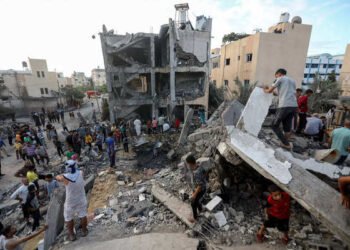
    Acknowledging the profound grief experienced by American Muslims who have lost family members in the Gaza conflict, Biden lamented the staggering toll of casualties, which includes nearly 30,000 Palestinians and over 1,200 Israelis, with hundreds more held captive. The President emphasized the plight of the approximately 2 million displaced Palestinians who urgently require essential provisions such as food, water, medical aid, and shelter.


    While Muslims worldwide observe Ramadan, Biden reaffirmed his commitment to alleviating the humanitarian crisis in Gaza. He pledged to lead concerted efforts to facilitate an immediate and sustainable ceasefire, extending over a six-week period, contingent upon the release of hostages. Additionally, Biden reiterated the United States’ unwavering support for a two-state solution, emphasizing the need for both Palestinians and Israelis to coexist in peace, security, and prosperity.


    Biden highlighted ongoing US-led initiatives to expedite the delivery of humanitarian assistance to Gaza through various channels, including land, air, and sea routes. He outlined recent measures, including the deployment of military assets to establish a temporary pier along Gaza’s coastline to facilitate large-scale aid shipments. Airdrops of aid, in collaboration with international partners like Jordan, are being conducted to reach vulnerable populations. Biden emphasized the importance of cooperation with Israel to expand aid distribution channels and ensure the unimpeded flow of assistance to those in need.


    In his address, Biden condemned the resurgence of Islamophobia in the United States and reaffirmed his administration’s commitment to combating discrimination and bias targeting Muslim, Sikh, South Asian, and Arab American communities. He announced the development of the first-ever National Strategy to Counter Islamophobia and Related Forms of Bias and Discrimination, aimed at eradicating hate and fostering inclusivity and respect for diversity.


    Biden reiterated the foundational principles of the United States, emphasizing freedom of worship and the rich contributions of immigrants, including Muslim Americans, to the nation’s fabric. He reassured Muslim Americans of their valued status within the American family and condemned any form of prejudice or bigotry based on religion or ethnicity.


    As Muslims embark on the sacred journey of Ramadan, President Biden extended his heartfelt wishes for a safe, healthy, and blessed month. He urged those grieving amidst the conflict in Gaza to find solace in their faith, family, and community. Biden concluded his message with the traditional Ramadan greeting, “Ramzan Kareem,” symbolizing goodwill, compassion, and unity during this auspicious period.

  • President Biden’s Third State of the Union Address

    President Biden’s Third State of the Union Address

    On Friday morning (IST), President Joe Biden delivered his third State of the Union address, confronting a multitude of challenges including a strained US economy and the management of conflicts such as the Israel-Hamas war and the Russia-Ukraine conflict.


    Opening his speech with fervor, President Biden launched a scathing critique against his November presidential election adversary, Donald Trump, cautioning that the foundations of US democracy are being threatened.


    In a gripping commencement, Biden expressed his intent to “awaken Congress and alert the American people” to this perilous situation, emphasizing that “freedom and democracy” were facing significant threats.


    He called for support for Ukraine, advocating for increased military aid to assist the nation in its conflict with Russia. Biden made a resolute pledge not to yield to Russian President Vladimir Putin, sharply denouncing Trump’s approach in his State of the Union address.


    Addressing the joint session, Biden declared, “My predecessor, a former Republican president, tells Putin, ‘Do whatever the hell you want.’” Asserting his stance, Biden declared, “I will not bow down. In a literal sense, history is watching.”


    Biden warned, “If anybody in this room thinks Putin will stop at Ukraine, I assure you he will not.” Reiterating Ukraine’s plea for military assistance and weaponry to combat Russia, Biden emphasized that the aid sought was not in the form of US personnel.


    Additionally, highlighting the nation’s recovery from the pandemic, Biden showcased the resilience of the US economy, describing it as the “envy of the world.”


    He remarked, “Folks, I inherited an economy that was on the brink.” Biden underscored the remarkable achievements, noting, “Now our economy is literally the envy of the world. Fifteen million new jobs in just three years—a record. Unemployment at 50-year lows.”


    As his term nears its conclusion and with the upcoming Presidential election in November, the speech marked a pivotal moment for President Biden, seeking to persuade voters to grant him a second term in the White House.


    Meanwhile, the Biden team announced a significant fundraising milestone. According to a post by Deputy Campaign Manager Rob Flaherty, “We’ve already raised $1 million online today and POTUS is still an hour away from hitting the stage! Our million+ person grassroots donor community (a third of whom are new to the campaign since ‘20!) is strong and growing stronger!”

  • Sanctions Imposed by President Biden Against Russia

    Sanctions Imposed by President Biden Against Russia

    United States President Joe Biden made a significant announcement on Friday, revealing nearly 500 new sanctions against Russia. These measures were imposed in response to Russia’s ongoing invasion of Ukraine and in light of the custodial death of prominent opposition leader Alexei Navalny, a vocal critic of Russian President Vladimir Putin.


    President Biden specified that the sanctions would target individuals associated with Navalny’s imprisonment and Russia’s military activities. This latest wave of sanctions, described by the Treasury Department as the largest single tranche since the beginning of the conflict, coincides with the second anniversary of Russia’s invasion of Ukraine.


    In addition to focusing on individuals linked to Navalny’s case, the new sanctions are expected to target Russia’s financial sector, defense industrial base, procurement networks, and entities involved in evading sanctions across multiple regions. President Biden emphasized that these measures would increase the cost for Putin’s aggression abroad and his repression within Russia.


    Moreover, President Biden explicitly held Putin responsible for Navalny’s death, asserting that the Russian leader must be held accountable. Biden disclosed that he had privately met with Navalny’s widow and daughter, Yulia and Dasha Navalnaya, in California, describing Navalny as a man of incredible courage.


    The death of Navalny, who barely survived a poisoning incident in 2020 that he blamed on Russian government agents, has sparked widespread condemnation globally. Several European governments have summoned Russian diplomats to protest Navalny’s death, while Britain has imposed sanctions on officials at the Siberian penal colony where he died.


    Alongside the announcement of new sanctions, President Biden also urged Congress to allocate funding for new military aid to Ukraine. This appeal comes at a crucial time, as US military support to Ukraine has faced obstacles due to political disputes in Congress, even as Russia has recently made significant gains on the battlefield.


    Despite facing sanctions and condemnation over its actions in Ukraine, the Russian economy is expected to continue growing this year, albeit at a slower pace. Russia is adapting to the sanctions and increasingly relying on trade with non-Western partners, particularly China, to mitigate the impact of Western sanctions.

  • President Biden Faces Scrutiny Over Memory Concerns

    President Biden Faces Scrutiny Over Memory Concerns

    US President Joe Biden found himself under scrutiny on Thursday as he responded to a report by Special Counsel Robert Hur that raised doubts about his memory and alleged mishandling of classified documents. Despite Biden’s emotional defense, denying any intentional wrongdoing, the report’s depiction of his memory deficiencies has raised concerns about his ability to effectively lead the nation.


    Biden’s passionate rebuttal came in the wake of assertions made in the report, which questioned his recollection of significant events, including the date of his son’s death. Expressing disbelief and indignation, Biden challenged the legitimacy of such claims, adamantly asserting the accuracy of his memory.


    However, the report from Special Counsel Robert Hur painted a contrasting picture, portraying Biden’s memory as “hazy,” “fuzzy,” and characterized by “significant limitations.” It detailed instances where Biden struggled to recall pivotal moments in his life, casting doubt on his cognitive abilities and capacity to lead effectively.


    While the report ultimately concluded that Biden would not face charges for mishandling classified documents, its findings regarding his memory raise questions about his suitability for office. The portrayal of his memory deficiencies could potentially undermine public confidence in his ability to govern and make sound decisions on behalf of the nation.


    Biden’s legal team pushed back against the report, disputing its accuracy and criticizing what they perceived as unjust attacks on the president’s character. Despite their efforts to discredit the findings, the report’s conclusions have reignited debates about Biden’s fitness for office and his capacity to fulfill the duties of the presidency.


    Special Counsel Robert Hur, appointed by Attorney General Merrick Garland in January 2023, conducted the investigation following the discovery of classified records in Biden’s Washington office. Subsequent searches, coordinated voluntarily by Biden’s staff, uncovered additional sensitive documents related to his tenure as vice president and senator.


    While evidence of willful retention and disclosure of certain records was found, particularly concerning a troop surge in Afghanistan, the report highlighted a lack of conclusive evidence to prove that Biden knowingly placed classified documents in a box in his Delaware garage. Some of the classified information related to Afghanistan was shared with a ghostwriter for Biden’s memoirs, raising concerns about potential security breaches.


    In response to the report’s findings, Biden expressed relief that no charges would be brought against him, emphasizing that the matter was now closed. Despite the controversy surrounding the investigation, Biden remains steadfast in his commitment to transparency and accountability in government operations.


    Nevertheless, the report has sparked renewed scrutiny of Biden’s leadership abilities and has raised questions about his fitness to serve as president. As the nation grapples with pressing challenges at home and abroad, concerns about Biden’s cognitive health and decision-making capabilities loom large, casting a shadow over his administration’s agenda.


    In the face of mounting criticism and skepticism, Biden will need to address these concerns head-on, demonstrating clarity of thought and decisive action to reassure the American people of his ability to lead the nation effectively. Only time will tell whether Biden can overcome these challenges and restore confidence in his leadership.

  • President Biden’s Call for Peace Amid Israel-Hamas Conflict

    President Biden’s Call for Peace Amid Israel-Hamas Conflict

    US President Joe Biden has made a strong call for peace amid the Israel-Hamas conflict, emphasizing the need for safety, dignity, and peace for both Israelis and Palestinians. He underscored that a two-state solution is the key to resolving the long-standing conflict.


    Taking to the social media platform X, President Biden conveyed his message, stating, “Even though it’s incredibly challenging, we must not abandon the pursuit of peace. We must continue to work towards a two-state solution.” He also expressed the importance of Israel and Ukraine’s success for national security, drawing from history to highlight the consequences of inaction against terrorists and dictators.


    On October 20, President Biden suggested that the recent attack by Hamas on Israel may have been influenced by concerns about Israel’s normalization of relations with Saudi Arabia. He made this observation during a campaign fundraiser, indicating that his planned meeting with Saudi officials might have triggered the Hamas assault on Israel, which occurred on October 7.


    The President noted that the Saudi government had been moving toward recognizing Israel, and this development might have been a factor motivating Hamas to act. In September, Israeli Prime Minister Benjamin Netanyahu, during a meeting with President Biden on the sidelines of the UN General Assembly, expressed optimism about the potential for a historic peace agreement between Israel and Saudi Arabia.


    The effort to normalize relations was initiated in September at the Group of 20 summit held in India, with discussions centered on a shipping corridor collaboration. Saudi Arabia had been advocating for the protection of Palestinian rights as part of a comprehensive agreement with Israel. The success of such an agreement could potentially lead to increased recognition of Israel by other Arab and Muslim-majority nations. Historically, many Muslim-majority countries have opposed Israel since its creation in a region where Palestinians have long resided.


    Secretary of State Antony Blinken also suggested that the leadership of Hamas may have been driven by a desire to obstruct diplomatic relations between Israel and Saudi Arabia.


    Pope Francis has also joined in appealing for peace and expressed deep concern about the dire situation in Gaza. He has called for efforts to prevent a humanitarian catastrophe.


    President Biden has consistently expressed strong support for Israel following the attack by Hamas on October 7. The Israeli military’s response has amplified the humanitarian crisis in Gaza, posing a significant threat to the escalation of the conflict. Casualties on both sides have been substantial, with over 1,400 Israelis and 4,137 Palestinians killed. Additionally, following the initial attack, Hamas took more than 200 individuals as hostages.

  • Biden: ‘Deep Sadness and Outrage’ Over Gaza Hospital Bombing

    Biden: ‘Deep Sadness and Outrage’ Over Gaza Hospital Bombing

    President Biden’s visit to Israel, aimed at reaffirming the United States’ unwavering support for its ally and preventing the Israel-Hamas war from escalating into a broader regional conflict, was overshadowed by a tragic event. Just hours after his arrival, a devastating airstrike hit a Gaza Strip hospital, resulting in the loss of nearly 500 lives. The hospital bombing incident has sent shockwaves around the world and added to the grim toll of civilian casualties in the ongoing Israel-Hamas conflict.


    The attack on the Al Ahli Hospital in Gaza triggered a dispute between the parties involved, with Hamas blaming Israel for the tragedy, while the Israeli Defense Forces claimed that a missile misfired from the Islamic Jihad militant group was responsible for the casualties. The immediate aftermath of the strike saw horrifying scenes as the hospital’s medical staff struggled to cope with the influx of wounded and dismembered patients.


    During a meeting with Israeli Prime Minister Benjamin Netanyahu, President Biden expressed his profound sadness and outrage over the hospital explosion and bombing. He made it clear that he believed Hamas did not represent all Palestinians and that their actions had brought suffering to the Palestinian people.


    President Biden appeared to stand with Israel by stating, “Based on what I’ve seen, it appears as though it was done by the other team, not you.” However, he acknowledged that there was some uncertainty regarding the cause of the blast, saying, “There are a lot of people out there who aren’t sure what caused the blast.”


    Biden reiterated the United States’ commitment to supporting Israel, while Netanyahu emphasized his government and the Israeli Defense Forces’ determination to minimize civilian casualties. President Biden had initially planned to visit Jordan after his stop in Israel, but meetings with Arab leaders were canceled following the hospital explosion and bombing.


    President Biden’s remarks reflected the horrors that both Israelis and Palestinians have endured during the conflict. He stressed the need to find ways to provide life-saving assistance to innocent Palestinians caught in the midst of the crisis.


    While expressing his support for Israel, Biden also highlighted the suffering of the Palestinian people in Gaza. He stated that Hamas had “slaughtered” Israelis in an attack in October and described the harrowing experience of innocent Israelis, including children.


    Prime Minister Netanyahu expressed his gratitude for President Biden’s visit, describing it as “deeply, deeply moving.” He conveyed the appreciation of all Israelis and underscored the importance of the United States standing with Israel in the face of the ongoing conflict.


    In response, Netanyahu drew a clear line between the “forces of civilization and the forces of barbarism.” He emphasized Israel’s commitment to defeating Hamas and called for unity in the civilized world against the militant group.


    Meanwhile, Hamas accused the U.S. of being “complicit in the massacres” in Gaza and criticized the endorsement of the Israeli narrative by the U.S. administration.


    As the conflict continues, Israel is preparing for a potential ground invasion of Gaza in response to Hamas’ attacks. The toll of civilian casualties in Gaza remains distressingly high, with approximately 2,800 Palestinians reported killed by Israeli strikes, and an estimated 1,200 people believed to be buried under the rubble. The recent hospital blast at Al-Ahli has added to the tragedy, and a clear cause for the explosion is yet to be established. The international community continues to call for a ceasefire and a resolution to the conflict to prevent further loss of innocent lives.