Tag: Political Career

  • Canadian PM Justin Trudeau Contemplates Quitting

    Canadian PM Justin Trudeau Contemplates Quitting

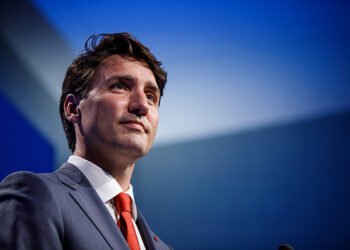
    Canadian Prime Minister Justin Trudeau, whose political career has been marked by highs and lows, recently opened up about the challenges he faces and admitted to contemplating quitting his role as Prime Minister on a daily basis. Trudeau’s candid remarks come at a time when his Liberal Party is trailing in the polls, facing the possibility of defeat by the right-of-center Conservative Party in the next federal election.


    Trudeau, who first assumed office in November 2015, has been grappling with dwindling public support, with recent surveys indicating a significant lead for the Conservatives. The upcoming election, scheduled to be held by October 2025, looms as a crucial test for Trudeau and his party. Despite the grim outlook, Trudeau remains determined to stay in office until the next election, expressing his commitment to continue leading the country despite the daunting challenges.


    In a revealing interview with French-language broadcaster Radio-Canada, Trudeau acknowledged the immense pressure and personal sacrifices that come with his role as Prime Minister. He admitted to contemplating quitting his “crazy job” every day, highlighting the demanding nature of political leadership and the toll it takes on individuals. However, despite the difficulties, Trudeau emphasized his unwavering dedication to serving the Canadian people and defending democratic values amidst global challenges.


    Trudeau’s remarks shed light on the intense scrutiny and criticism that political leaders endure, particularly during times of political turbulence and uncertainty. As the face of the Liberal Party, Trudeau has faced criticism from various quarters, including his handling of key issues such as climate change, the economy, and housing affordability. The resurgence of the Conservative Party, led by Erin O’Toole, has further intensified the political landscape, posing a formidable challenge to Trudeau’s leadership.


    One of the key policy differences between the Liberal and Conservative parties revolves around the issue of carbon pricing, with Trudeau’s government implementing a carbon tax aimed at curbing greenhouse gas emissions. The Conservatives have pledged to repeal the carbon tax if elected, arguing that it places undue financial burdens on Canadians. Trudeau’s steadfast commitment to environmental initiatives, despite opposition from some provincial leaders, underscores his determination to address climate change and uphold Canada’s international commitments.


    In addition to environmental policies, Trudeau’s government has faced criticism over its handling of the national budget deficit and the ongoing housing crisis. The rising cost of housing, particularly in major cities like Toronto and Vancouver, has left many Canadians struggling to afford homeownership, prompting calls for government intervention. Trudeau has promised to address the housing affordability issue through various measures, including incentives for first-time homebuyers and investments in affordable housing projects.


    Trudeau’s personal life has also come under scrutiny, with his announcement last year of his separation or quitting from his wife, Sophie Grégoire Trudeau, after 18 years of marriage. The revelation added a personal dimension to Trudeau’s public image, highlighting the challenges of balancing political responsibilities with personal relationships.


    Despite the mounting pressures and personal setbacks, Trudeau remains resolute in his determination to lead Canada through turbulent times. His commitment to public service and belief in the value of democracy underscore his enduring legacy as a political leader. As the country navigates the complexities of a changing political landscape, Trudeau’s leadership will continue to be tested, with the outcome of the next election shaping the future trajectory of Canada’s political landscape.

  • Rishi Sunak Proud to be 1st British Asian PM

    Rishi Sunak Proud to be 1st British Asian PM

    Rishi Sunak, the United Kingdom’s first Indian-origin Prime Minister, addressed his first Conservative Party conference as party leader in Manchester, delivering a pivotal speech that emphasized the UK’s non-racist identity and outlined his policy plans for the nation. The speech held significant importance as it came nearly a year after Sunak assumed leadership of the Tory party, with the general election expected next year.


    Before beginning his address, Sunak received a warm and personal introduction from his wife, Akshata Murty, who praised his “honesty, integrity, and strength of character.” Sunak then proceeded to lay out his vision and plans, aiming to secure the British public’s mandate in the forthcoming elections.


    In a powerful declaration, he stated, “Never let anyone tell you that this is a racist country. It is not.” He shared his personal journey, describing it as a “British story” that reflects how a family can progress from arriving in the UK with little to reaching Downing Street in just three generations.


    Sunak highlighted the diversity within his own Cabinet, pointing to Indian-origin Home Secretary Suella Braverman and Energy Secretary Claire Coutinho among his frontline members. He underlined the opportunities that the Conservative Party offers migrant families, including the chance to become Prime Minister, thereby challenging the notion that racial background should determine one’s success in politics.


    Reflecting on his initial selection by the local Conservative Association to contest the Richmond constituency in North Yorkshire, a seat he has held since 2015, Sunak addressed the misconceptions and prejudices that had arisen. He recalled how an American magazine had sent a reporter to Yorkshire, questioning whether “a candidate of the wrong race” could affect one of England’s safest seats. However, Sunak emphasized that his constituents were interested in his character rather than his color, and he affirmed his pride in being the first British Asian Prime Minister.


    In his speech, Rishi Sunak emphasized the importance of making long-term decisions to transform the UK for a brighter future. He announced the cancellation of the remaining High-Speed 2 (HS2) railway project and redirected £36 billion towards broader transport initiatives. Additionally, he unveiled policy plans, including a proposal to raise the smoking age incrementally, ensuring that future generations grow up smoke-free.


    Regarding the education system, Sunak introduced the “Advanced British Standard,” which merges A-Levels and T-Levels into a single qualification for school leavers. This move aims to promote parity between academic and technical education and ensure that all students leave school with literacy and numeracy skills.


    Rishi Sunak’s conference speech has been regarded as a defining moment in his term as Prime Minister and has set the tone for his government’s policy agenda in the lead-up to the upcoming general elections. His message of inclusivity and opportunities for all, regardless of background, resonates with the evolving face of British politics and society.