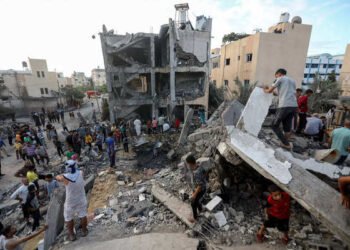
Tag: Ground Invasion

  • Israel Threatens Ground Invasion in Rafah

    Israel Threatens Ground Invasion in Rafah

    In a stern warning to Hamas, Benny Gantz, a member of Israel’s war cabinet, has issued an ultimatum: all hostages must be released by March 10, or Israel will launch a ground invasion in Rafah. The backdrop to this warning is the current crisis in Gaza, where 1.5 million Palestinians are seeking refuge in Rafah, a city near the Egypt border. International agencies have expressed grave concerns, warning that any attack on Rafah could result in a humanitarian catastrophe.


    With the death toll from Israeli airstrikes in Gaza surpassing 28,000, peace efforts led by Egypt, Qatar, and the United States have thus far failed to bring about significant progress on the ground. Despite repeated warnings from Israel’s closest ally, the US, urging the Benjamin Netanyahu-led government to cease its attacks on civilians, Israeli forces have continued their indiscriminate assaults.


    Here are 10 key points to understand the Israel-Hamas conflict in Rafah:

    • The Israeli government has issued an ultimatum to Hamas, demanding the release of hostages by the start of Ramadan on March 10. Failure to comply will result in the IDF launching a ground offensive in Rafah, with Israeli authorities citing reliable intelligence indicating that most hostages are being held in the city.


    • Benny Gantz emphasized that Israel is coordinating closely with its allies, including the United States, to evacuate civilians and minimize civilian casualties in the event of a ground invasion.


    • Egypt has made it clear that it will not allow Palestinian refugees to enter its territory. Cairo is concerned that the conflict between Israel and Hamas could spill over into Rafah, potentially leading to an influx of Palestinian refugees into Egypt.


    • There have been reports from Israel suggesting that the government aims to expel Palestinians from Gaza as part of a resettlement plan, paving the way for Israeli citizens to return to the territory.


    • The International Court of Justice (ICJ) has convened for a second time to address the plight of Palestinians in Gaza amid the Israel-Hamas conflict.


    • Representatives from the United Nations General Assembly (UNGA), Israel, and the Palestinian Authority presented their arguments before the ICJ. The UNGA sought an advisory opinion from the ICJ on the consequences of Israel’s actions, including its occupation, settlement, and annexation policies.


    • Palestinian Foreign Affairs Minister Riyad al-Maliki highlighted the dire humanitarian situation in Gaza, with millions of Palestinians besieged, bombed, and displaced. He emphasized the need for the ICJ’s ruling to pave the way for peace and security for both Palestinians and Israelis.


    • Al-Maliki expressed optimism that the ICJ’s decision could contribute to a peaceful resolution of the conflict, allowing Palestinians and Israelis to coexist in dignity and security.


    • Israeli Prime Minister Benjamin Netanyahu rejected the legitimacy of the ICJ’s hearings on the occupation of Palestinian territory, dismissing the proceedings as part of a Palestinian attempt to dictate political outcomes without negotiations.


    • Netanyahu emphasized that Israel does not recognize the authority of the ICJ in matters related to the Israeli-Palestinian conflict, characterizing the discussions at The Hague as part of a broader Palestinian strategy to circumvent negotiations.


    The situation in Rafah remains tense as Israel issues a deadline for the release of hostages held by Hamas. With international efforts to broker peace faltering and the humanitarian crisis worsening, the prospect of a ground invasion looms large, raising concerns about the escalation of violence and the plight of civilians caught in the crossfire.

  • Israel Escalates Bombardment of Gaza as Tensions Rise

    Israel Escalates Bombardment of Gaza as Tensions Rise

    Israel has significantly increased its airstrikes on Gaza overnight, raising fears of an impending ground invasion as the conflict with Hamas enters its third week. Israeli forces have called for residents in North Gaza to leave the area, dropping leaflets that warn of the danger of staying. The ongoing violence has also led to Israeli airstrikes in Syria and the West Bank, further escalating the situation.


    In the ongoing Israel-Gaza conflict, Israel has intensified its airstrikes on Gaza, prompting concerns about the possibility of a ground invasion. The conflict, which began as a response to Hamas’s attack on October 7, has entered its third week, with no immediate resolution in sight.


    Israel has repeatedly called on residents in North Gaza to leave the area, issuing warnings through leaflets dropped from the air. These warnings emphasize that staying in North Gaza, particularly north of Wadi Gaza, could place lives in danger. Furthermore, individuals who choose not to relocate to the south of Wadi Gaza might be identified as accomplices to a terrorist organization, as stated in the leaflet.


    Israeli warplanes have continued to strike targets across Gaza, and the conflict has expanded to involve attacks on two airports in Syria and a mosque in the occupied West Bank, which is alleged to have been used by militants. The situation has raised concerns that the two-week-old war with Hamas could lead to a broader and more complex regional conflict.


    The Israel-Gaza conflict has also spilled over into tensions with Lebanon’s Hezbollah militant group. Israel has engaged in near-daily exchanges of fire with Hezbollah since the conflict began. Additionally, there is growing tension in the Israeli-occupied West Bank, where Israeli forces have clashed with militants in refugee camps and conducted two recent airstrikes.


    The looming possibility of a ground offensive by Israel has been a major concern. Tanks and tens of thousands of troops have gathered at the border, and Israeli leaders have indicated that the conflict is entering an undefined “next stage” in its operations. While Israel has estimated that approximately 700,000 people have already fled the affected areas, hundreds of thousands remain in Gaza. This situation raises significant concerns about the potential for mass civilian casualties if a ground offensive is launched.


    Israeli military officials have noted that Hamas’ infrastructure and underground tunnel system are concentrated in Gaza City. They have indicated that the next stage of the offensive may involve unprecedented force in the city, potentially leading to a further escalation of the conflict.


    The Israel-Gaza conflict continues to evolve, with significant implications for the region and the safety of civilians caught in the crossfire. The international community remains concerned about the ongoing violence and its potential consequences.