Tag: cooperation

  • China Supports Maldives’ Territorial Sovereignty

    China Supports Maldives’ Territorial Sovereignty

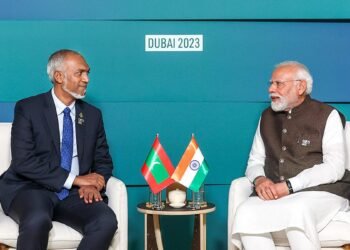
    Amidst regional tensions, the recent withdrawal of Indian military personnel from the Maldives has sparked reactions from China, signaling potential shifts in regional dynamics and foreign relations. The move comes after the Maldivian President Mohamed Muizzu requested India to withdraw its forces from the archipelago island, raising questions about territorial sovereignty and strategic alliances in the Indian Ocean region.


    The first batch of Indian military troops stationed in the Maldives reportedly began withdrawing from the country following President Muizzu’s request. As reported by Mihaaru newspaper, 25 Indian troops deployed in the southernmost atoll of Addu left the Maldives ahead of the March 10 deadline. The withdrawal process was said to have commenced after the Indian military personnel handed over the operations of surveillance aircraft/helicopters to an Indian civilian crew.


    While there was no official confirmation from either the Maldivian or Indian authorities, Mihaaru claimed that the Maldivian National Defence Force confirmed the withdrawal of Indian troops. This development follows President Muizzu’s earlier statement in January, where he urged India to withdraw nearly 90 military personnel from the Maldives. He later announced that no Indian military personnel, including those in civilian attire, would be allowed in the country after May 10.


    The withdrawal of Indian troops from the Maldives has drawn attention from China, with spokesperson Wang Wenbin expressing China’s support for the Maldives in safeguarding its territorial sovereignty. Wenbin’s statement, reported by China’s state media Global Times, emphasized China’s stance on maintaining friendly cooperation with all sides based on independence. The Chinese Foreign Ministry spokesperson’s response underscores China’s interest in the region and its strategic positioning vis-à-vis India.


    In response to inquiries about the specifics of the Indian troop withdrawal, Wang Wenbin stated that he was not aware of the details. However, his affirmation of China’s support for the Maldives reflects China’s broader foreign policy objectives and regional interests. China’s engagement with the Maldives and other South Asian countries has intensified in recent years through infrastructure projects, economic assistance, and military cooperation, raising concerns among Indian policymakers about China’s growing influence in the Indian Ocean region.


    The withdrawal of Indian military personnel from the Maldives comes amidst a backdrop of geopolitical competition between India and China in the Indian Ocean. Both countries have sought to expand their influence in the region through infrastructure development, economic partnerships, and military cooperation with smaller Indian Ocean littoral states. The Maldives, strategically located in the Indian Ocean, has become a focal point in this power struggle, with both India and China vying for influence in the archipelago.


    China’s reaction to the withdrawal of Indian troops from the Maldives underscores its strategic interests in the region and its efforts to consolidate its influence in South Asia. In addition to expressing support for the Maldives’ territorial sovereignty, China has been actively engaging with other countries in the region, including Sri Lanka and Nepal, to strengthen defense ties and deepen cooperation on regional security issues. The recent visit of a Chinese military delegation to the Maldives, Sri Lanka, and Nepal highlights China’s growing military presence and influence in South Asia.


    In recent years, China has stepped up its engagement with the Maldives through investments in infrastructure projects and economic assistance. The signing of a “military assistance” deal between China and the Maldives, under which China will provide ‘non-lethal’ weapons to the Maldives free of cost, reflects China’s expanding military cooperation with Indian Ocean littoral states. This deal, along with other Chinese investments in the Maldives, has raised concerns in India about China’s growing influence and strategic presence in the region.


    The withdrawal of Indian military personnel from the Maldives, territorial sovereignty and China’s response to the development highlight the complex geopolitical dynamics at play in the Indian Ocean region. As major powers like India and China compete for influence in the strategically important region, smaller states like the Maldives find themselves caught in the middle, balancing between competing interests and strategic partnerships. The evolving security environment in the Indian Ocean underscores the need for regional cooperation and dialogue to address common challenges and maintain peace and stability in the region.

  • Haryana and Rajasthan Clash Over Cooperation in Investigations

    Haryana and Rajasthan Clash Over Cooperation in Investigations

    Tensions have escalated between the states of Haryana and Rajasthan after Haryana Chief Minister Manohar Lal Khattar offered assistance to Rajasthan Police in the case involving Monu Manesar, a Bajrang Dal member accused in multiple criminal incidents. This move has drawn criticism from Rajasthan’s Chief Minister Ashok Gehlot, who accused Haryana of lacking cooperation in previous cases.


    The dispute stems from the investigation into the Bhiwani killings, where two Muslim men, Junaid and Nasir, were tragically burned to death. Monu Manesar is also linked to the Nuh communal violence, which resulted in six fatalities.


    During a press conference, Haryana Chief Minister ML Khattar expressed readiness to aid Rajasthan in investigating Monu Manesar. However, he stated that Haryana has no information about Monu Manesar’s whereabouts, leaving the Rajasthan Police to take action as they see fit.

    Responding to Khattar’s offer, Ashok Gehlot accused Haryana of failing to establish cooperation when Rajasthan Police attempted to arrest the accused in the Nasir-Junaid murder case. Gehlot highlighted that Haryana Police not only withheld cooperation but also registered an FIR against the Rajasthan Police during the earlier incident.


    In a tweet, Gehlot criticized Khattar’s recent statements as a diversion tactic and mentioned that Haryana’s Police were uncooperative in finding the absconding accused. He criticized Khattar’s failure to prevent violence in Haryana and his alleged attempt to divert public attention from ongoing issues.


    The clash between the two state governments reflects a broader concern over cooperation in criminal investigations and highlights the complex dynamics between neighboring states.


    Communal clashes between two communities in Nuh, Haryana, have resulted in at least six deaths and numerous arrests. Around 90 individuals have been detained in connection with the violence. The accusations and counter-accusations between Haryana and Rajasthan further complicate the situation and underscore the need for effective cooperation between law enforcement agencies across state borders.

  • India and Philippines Consider Cooperation on UPI

    India and Philippines Consider Cooperation on UPI

    India and the Philippines are currently in the early stages of exploring a potential collaboration that could revolutionize digital payments in both countries. The heart of this collaboration lies in the integration of India’s pioneering Unified Payments Interface (UPI) with the digital payment systems of the Philippines. This forward-looking proposal was set in motion by none other than India’s external affairs minister, S. Jaishankar, during a significant meeting with his Philippine counterpart, Enrique Manalo, in June.


    While no official confirmation has emerged from the Ministry of External Affairs regarding this collaboration, the idea is very much in line with India’s strategic vision of expanding the global footprint of UPI. The National Payments Corporation of India (NPCI), the entity responsible for UPI, has expressed a keen interest in establishing interoperability between UPI and international digital payment platforms. This initiative is poised to create seamless cross-border transactions, encompassing remittances and merchant payments.


    The backdrop of this potential collaboration gains substantial importance through the memorandum of understanding (MoU) inked between India and the Philippines in June. The MoU is specifically tailored to the realm of financial technologies. It outlines the formation of a Joint Working Group that will delve into possible collaborations across various domains, such as fintech innovations, digital governance, interoperable APIs, payment linkages, and financial inclusion strategies.


    This budding partnership has significant implications for the Indian diaspora residing in the Philippines, a community numbering around 130,000 individuals. The simplification of sending money back to India via efficient and secure digital payment platforms could be a game-changer. It not only promises to enhance the ease of financial transactions for overseas Indian workers but also solidifies the economic ties between the two nations.


    While discussions are still in their infancy, the potential integration of UPI with the digital payments ecosystem of the Philippines holds the promise of bolstering financial inclusivity and fostering more profound economic cooperation between these two dynamic nations. If realized, this collaboration could propel both India and the Philippines to the forefront of digital financial innovation and transformation.

  • Manipur CM to Remain Amid Calls for Dismissal

    Manipur CM to Remain Amid Calls for Dismissal

    Amidst growing demands for the dismissal of Manipur Chief Minister N Biren Singh due to the ongoing ethnic clashes in the state, Home Minister Amit Shah announced in the Lok Sabha that Singh would retain his position as he is “cooperating with the Centre.” Shah’s statement came during a discussion on a no-confidence motion.


    Shah emphasized that a change in leadership is warranted when a Chief Minister is not cooperative. However, in the case of Manipur, Shah expressed that Singh’s collaboration with the Centre makes his continuation feasible. Shah further appealed to both the Meitei and Kuki communities to refrain from violence and engage in dialogue with the government.


    The recent ethnic clashes in Manipur have resulted in over 150 casualties, prompting concerns about the efficacy of the state’s leadership. Opposition leaders, including the Congress party, have criticized Singh’s performance, asserting that the people of Manipur have lost confidence in his leadership.


    The opposition’s criticism intensified after the Kuki People’s Alliance withdrew its support from the N Biren Singh government. The Congress party contended that there was a growing “mistrust” between the BJP government in the state and the central BJP government.


    During the Lok Sabha discussion, Congress MP Gaurav Gogoi expressed skepticism about Singh’s cooperation with the Centre, citing instances of arms being looted from police stations and the displacement of thousands of people into shelter camps. Gogoi questioned the nature of cooperation that results in such incidents and urged Prime Minister Narendra Modi to consider removing the Chief Minister on moral grounds.


    Congress general secretary Jairam Ramesh highlighted the recent filing of an FIR by Manipur Police against Assam Rifles, a move he described as a “breakdown of Constitutional machinery.” Ramesh also raised concerns about the strained relationship between the BJP government in Manipur and the central BJP government.


    As the situation in Manipur continues to unfold, the debate over Chief Minister N Biren Singh’s leadership, dismissal and the response of the central government to the state’s challenges remains a focal point of discussion among political circles.